
Ever since Covid-19 took over our collective lives and attention, there seems to have been an explosion of mental health articles on the internet, advocating for the public use of knowledge and resources used in psychotherapy. Yet how are therapy clients living through all of this and what does it mean for therapists and society as a whole?
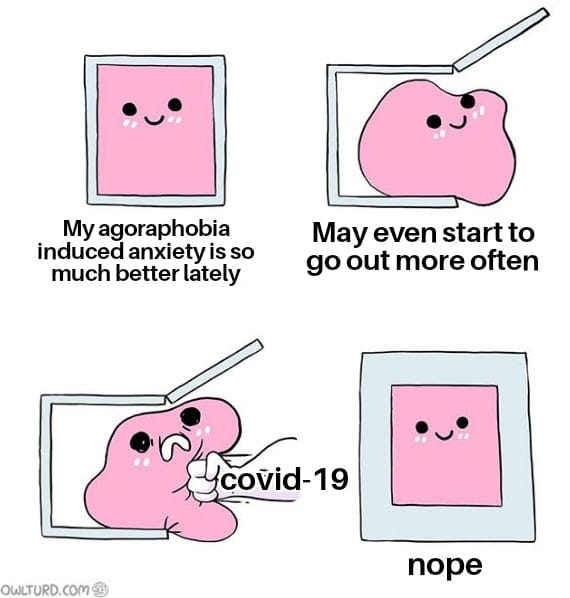
Two weeks ago, in Portugal, my life changed. I had to go from being a therapist who sees people predominantly in a face-to-face setting and occasionally via online means (generally when my clients travel or move countries) to somebody working fully and exclusively online. Working in Lisbon, with expats and urban national clients, I am used to people who travel. Like many at this very unusual point of our lives, I am also getting used to working predominantly from home, with all that it currently implies, from negotiating rules of cleaning and disinfection with the people I live with, to setting boundaries and sharing common spaces. Like others in their forties navigating this crisis, I try to keep my own health in check while worrying about elderly parents and their well-being. And while trying to figure myself out and my relations in the midst of all of this, I started wondering what effects this crisis would have on my former and current therapy clients. In doing so, I also came across the meme above, shared by a close friend. I was amazed how much this meme talks about what is going on at this point, in the relation between therapy clients and Covid-19.
Mental health ‘patients’ versus therapy clients: to be or not to be
Assuming a therapy client is mainly an individual suffering from mental health problems always feels to me like a gross shortcut. In family therapy, people who are pointed out as the ‘source’ of the problem by their families, are called the ‘identified’ patient. We called them ‘identified’ because truly, it takes at least two to tango, and in families, sometimes more. The identified patient is more often a messenger of what is going on in the wider family group. They are frequently the person who can’t just abide by denial or by accept the family rule of ‘stop seeing problems where there aren’t any’. When the ‘identified’ client (either self-identified or identified by others) comes for a significant bout of individual therapy, there are always individual changes but also changes between the client and their family/peer relationships. In short: calling a therapy client someone with a ‘mental health issue’ of some kind is a gross simplification. We carry (and are carried) by the relations that make our lives. Mental health exists in these relations much as in individual minds. Seeing what is happening to individual therapy clients in Covid-19 times is, once more, confirming that none of us is an island. Some of my clients, believe it not, are doing remarkably well.
Wait a second…so…less anxiety?
After two weeks of confinement and isolation, I am surprised how many of my clients are coping well with it. Anecdotally, in informal conversations with therapy peers, others seem to remark on this as well. Some friends have commented on people with long term histories of depression and anxiety, part of their personal groups, rising to the challenge and feeling stronger than ever. What can this change mean?
While holding to basic rules of anonymity and confidentiality, I would like to provide a snippet of what some of my clients are reporting at this point. Surrounded by a world swamped in anxiety, some of my clients now feel that there has been a ‘levelling up’ between their difficulties and the experience of the world around them. In a crisis situation where most people are being gradually identified by some form of anxiety, my clients no longer feel like the ‘identified’ ones. For others, as in the ‘agoraphobia’ meme shown above, what caused their anxieties (for instance, adventuring into open spaces or situations of closeness to people outside the family group) has now stopped offering a problem, as we isolate at home. People who were already isolated at some level sometimes report that they were somehow preparing for this. All of these seem to have been temporarily removed from the weight of their difficulties. What will happen when we leave our homes again, only time will tell.
Certain couples seem to be giving way on habitual fights, as the motives are suspended in significance (will we, or will we not, have a child soon). Other clients are taking a more spiritual path and seeing the crisis as a potential increase in collective meaning and a potential decrease in the ‘rat race’ culture. At some level, doing psychotherapy may indeed have served as a preparation for where we are now. Therapy clients were already seeking the stuff that the whole world now seems to be seeking incessantly on the internet, from managing stress to learning how to sit comfortably in one’s own company.
Where do we go from here, as therapists and therapy clients?
A therapists’ private office is a window on humanity, but hardly a direct mirror. On a wider scale, we are also seeing a potential increase in domestic violence for people locked up at home with their abusers, paired with the growing effects of inequality in a health crisis, particularly in populations who were already vulnerable to start with. These are but two groups of people who seldom make it to the therapy office.
In Portugal, no more than two weeks into confinement, we are learning as we go along. Where we stand in two weeks’ time will be different from where we stand in one or two months. And there is a global recession cooking.
Facing the enormity of this change, therapy may become a practice temporary less focused on behaviour modification, that is, in the things I want to see ‘less of’ or things I want to see ‘more of’, in myself and others. Rather, we may go back to therapy as a process of self-discovery but, perhaps more important, with an emphasis on value identification and practice. There are some lines of exploration we may start giving more time to, in the online therapy office and beyond it. For instance: what are my core values and how do I want to practise them in my life in relation to others (family, friends, co-workers, strangers in the street)? What values do I want my kids to embody as future citizens and how can we get there? What values do I want to see happening in society as a whole and how can I become part of the solution? In short: HOW do I want to live, meaningfully and mindfully, with others around me?
I look forward to this change, for new people coming into therapy and for former and current therapy clients. Because no one is an island and in therapy, more than many other things, it will always take two to tango.